How to find eco-friendly products online?
If you are looking for a sustainable and ethical product on the Internet, why not use a French or European solidarity search engine? You can then refine your search by studying the ecolabels, without falling into the trap of greenwashing. And once you have found the product of your dreams, you can have a look at the website’s hosting. In this article you will find a lot of information on how to find an eco-responsible product on the Internet.
Search and Save
A trivial thing such as using the right search engine could help save the planet. Most of us have never considered that our choice of search engine could actually have an impact on the environment.
Note: These search engines are not designed to find eco-friendly products but every click sponsors a cause.
There are now many types of search engines that aim to do more than just search for goods stuff. They are committed to do social good and search to save the planet. They are known as ‘green search’, ‘solidarity search’ or ‘socially conscious’ search engines.
- A ‘green’ engine moves away from high-energy, high-functionality features responsible for intensive energy and electricity use.
- ‘Transparent’ search engines do not have monitoring and user tracking systems that overload browsers and retain user data for marketing purposes.
- A ‘solidarity’ search engine turns every search into a benefit for the environment by financing humanitarian or environmental actions all over the world.
Note: If you want to know exactly where your click goes, check the charity partners and affiliates of the particular social solidarity engine you wish to use.
Look for the eco-label
Eco-labels and ‘green stickers’ are certification systems used for food and consumer products, particularly in regions such as the European Union, where the EU Ecolabel of environmental excellence has been in use since the early 90s.
Note: The use of ecolabels is voluntary, whereas green stickers are mandated by law.
Eco-labels can help identify ethical and/or environmentally friendly products, based on precise certification criteria.
Essentially, they guarantee that products and services carrying the label meet criteria aimed at reducing their environmental footprint throughout their life cycle, while remaining energy efficient overall. The absence of an eco-label on a product does not mean that it is not environmentally responsible, but an eco-label on a product can be a real guarantee of sustainability.
Note: Eco-labels should not be confused with energy labels, for items such as household appliances in the EU for example. Eco-label measures the life cycle energy efficiency while energy rating labels refer to energy consumption during the use of an appliance.
The main Eco-Labels in the EU
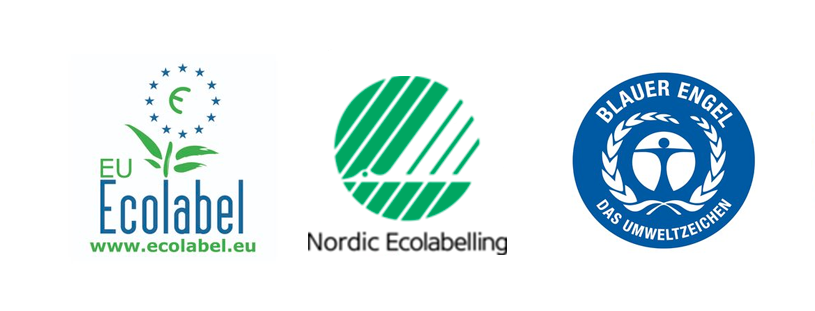
The European Ecolabel (ecolabel.eu), created in 1992 by the European Commission, is the only official European eco-label recognised in all European Union Member States.
It is only awarded to products and services that meet strict environmental standards throughout their life cycle: from sourcing raw materials, to the production process, distribution chain and disposal method. It works by encouraging suppliers and manufacturers to use processes that generate less waste and CO2 emissions to develop products that are durable, easy to repair and recycle.
In 2022, the label covers more than 80,000 product references across 23 categories.
Example: European Ecolabel wall paints contain 10 times less harmful substances than conventional products.
In France, the European ecolabel is managed by the Agency for Ecological Transition (ADEME) and the French Association for Standardisation (AFNOR).
Established in 1989, Nordic Ecolabelling, also known as the Nordic Swan, is the official eco-label of the Nordic countries (Denmark, Finland, Iceland, Norway and Sweden).
It works by setting strict environmental requirements across all the phases of a product’s life cycle and currently certifies 55 product groups and more than 25,000 products according to strict criteria that take into account important environmental aspects such as the use of sustainable raw materials and biodiversity, the circular economy and resource efficiency, energy use and climate impact, and avoidance of harmful chemicals, nano- and microplastics in manufacturing.
The Blue Angel (Blauer Engel) is a label created by the Federal Environment Agency in Germany. It certifies products based on strict criteria such as ecological processes and environmental impact.
The testing and certification criteria are developed by the German Environment Agency on a scientific basis and it currently manages a database of 20,000 products from 1,600 companies.
Many eco-labels in Europe cover high-volume, high-use consumer products that people tend to use every day, such as food products, hygiene articles, computers, textiles, furniture, paints, etc. Every European Union Member State has regulatory authorities and public organisations that work with both manufacturers and consumers, across all the sectors of the economy but also in specific fields, such as below.
Examples :
- In France, the main source of information on eco-labels is the website of the Agency for Energy Transition (ADEME).
- In Germany, the «Siegelklarheit» platform of the German Federal Ministry for Economic Cooperation and Development aims at making labels understandable to consumers.
- A German NGO certifies wood and paper products sourced from managed forests or plantations, taking into account social, economic, ecological and cultural aspects.
- In Italy, an eco-label sets specific standards assessing the overall sustainability of the activity of companies in the wine sector.
In addition to eco-labels and public sector guidelines, various associations or tech applications can help consumers reduce their environmental footprint and take eco-responsible action.
Example: Dutch organisation Milieu Centraal advises on sustainable consumption choices.
Organic Products Label
If you buy organic products online, look out for the following label.
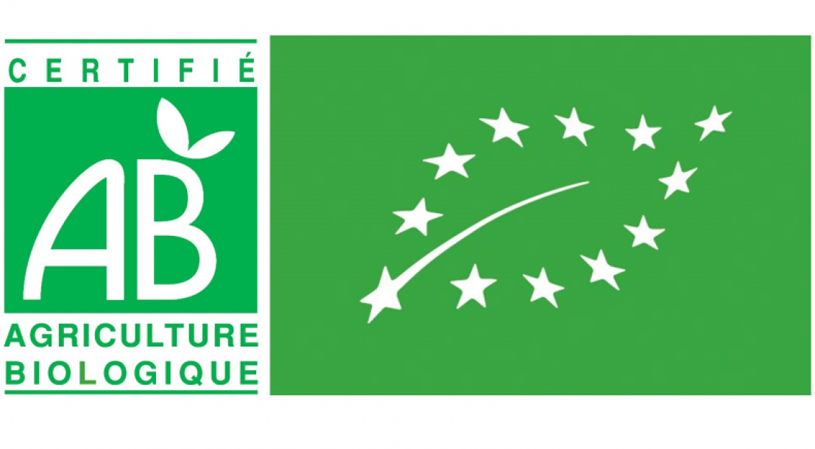
- The French Agriculture Biologique label by the Ministry of Agriculture and Food certifies that a product contains at least 95% certified-organic agricultural ingredients. Note that it is optional.
- The EU Organic Logo is the Europe-wide label for products that comply with organic farming specifications and it is mandatory for all products sold as ‘organic’, meaning they contain at least 95% organic ingredients. It must be accompanied by an indication of origin and the certification body details. In each Member State of the European Union, both national and private logos may be used for the labelling, presentation and advertising of organic products.
An European directive plans to further regulate sustainable development labels by 2026. These labels aim to distinguish and promote a product or company for its environmental or social characteristics, or both.
Labels that are not based on a certification system or established by public authorities will be banned. Displaying a non-certified label will be considered an unfair commercial practice.
Another European directive provides for greater supervision of environmental labels. These labels focus solely or mainly on the environmental characteristics of a product, a process or a trader.
For a trade to display an environmental label, it will have to go through a certification system. Among other things, this certification will make it possible to:
- Provide transparent and accessible information on the ownership, decisions taken and objectives of the label;
- Establish the criteria for obtaining the label;
- Set up a system for receiving and resolving complaints;
- Establish clear procedures for dealing with cases of non-compliance, including the possibility of withdrawing or suspending the label.
In order to avoid a rapid proliferation of environmental labels, the text seeks to prohibit the creation of new national or regional public environmental label schemes in the European Union.
The good news is that the list of environmental labelling schemes complying with the directive will be accessible free of charge.
Certification, label, accreditation: what are they?
Certification is a voluntary procedure requested by the seller or manufacturer of a product to have the quality of one or more of its products recognised, or to demonstrate that it complies with a specific standard. The seller or manufacturer must undertake to comply with a set of specifications containing a series of precise criteria.
An independent and impartial certification body checks compliance with these criteria. The certification body must be accredited to ensure its impartiality, competence and professionalism. In France, certification bodies such as the AFNOR are audited by the COFRAC.
A label, on the other hand, is a distinctive sign affixed to the labelled product to indicate that it complies with criteria defined in precise specifications.
Green or just greenwashing?
Greenwashing is when a manufacturer, seller, website or brand projects a respectable environmentally-friendly image but in fact fools consumers into believing the products are ecological.
There are many ways advertisements can deceive consumers. Remember not all products displaying a green sticker and environmental protection messaging is in fact organic or ecological. Deceptive commercial practices such as greenwashing constitute false advertising in some countries, like for example in France since the entry into force of the Climate and Resilience Law.
The directive on environmental claims, which is currently under draft, will not only regulate the system of environmental labels in the EU, but also the way in which a brand can boast about the environmental merits of his activities and products.
First of all, it will have to carry out an assessment to substantiate its environmental claims, in particular by:
- By specifying whether the claim concerns a product in its entirety or only one of its characteristics, or all or part of its activity;
- By relying on widely recognised scientific evidence;
- By demonstrating that the environmental impacts, characteristics or performance claimed are significant from the point of view of the product’s life cycle;
- By demonstrating that its claim does not simply correspond to requirements already laid down in regulations.
Finally, precise procedures will be laid down to enable the justification and communication of these environmental claims to be verified in advance by third-party bodies.
t physique ou via un lien internet ou un QR code.
How to spot greenwashing practices
Some sellers or service providers use questionable certifications in a misleading way. If you want to ensure that you are buying a ‘green’ product, check the official website of the label or certification body listed. Only labels that comply with the international standard ISO 14024 are genuine.
If you choose products based on their claiming to be 100% ‘green origin’, you may want to investigate further, particularly when it comes to cosmetics and personal hygiene products.
To make an informed choice, you may wish to learn more about a product’s ingredients, staying away from those known to be controversial or harmful.
Check a brand’s entire range to see if their environmental credentials are consistent across all of their products. This can often reveal a brand’s real commitment to environmental protection practices.
From September 2026, presenting an environmental claim concerning the whole of the trader’s product or business, when it concerns only one aspect of the product or a specific activity of the trader’s business, will be considered an unfair commercial practice at European Union level.
To reassure you, many sellers or brands use generic terms such as ‘sustainable’, ‘natural’, ‘climate-friendly’, ‘ecological’, ‘environmentally-friendly’, ‘biodegradable’, ‘biosourced’, ‘green’, ‘protects the planet’, ‘nature-friendly’ and other similar formulations.
These terms do not always refer to a particular environmental impact of the product, but suggest an overall benefit for the environment. From 2026, these generic claims will only be authorised if the trader using them can provide indisputable proof. Otherwise, they will be considered unfair to consumers.
- Some professionals specifically promote the durability of their products by highlighting the number of times they are used. This is the case for washing machines and tumble dryers, for example. Try to find out from different online reviews or tests whether this sustainability is real. From 2026, it will be forbidden to promise sustainability that is unfounded, such as an overestimated number of washing cycles for a new washing machine.
- Some sellers and brands also promote the biodegradable nature of the product. But they are over-packaged or packaged in polluting materials that are difficult to recycle.
- Other sellers misuse the term ‘eco-design’ when presenting an appliance. According to a European directive, appliances must be designed to meet a number of criteria and are therefore always ‘eco-designed’. Depending on how it is used, this label may lead you to believe that the product in question has a better environmental performance than another product in the same category.
Good to know: from 2026, presenting requirements already imposed by regulations as a distinctive feature of the product will be considered an unfair commercial practice at EU level.
- Many retailers are fond of the terms ‘carbon neutrality’, ‘zero net emissions’ or ‘negative carbon footprint’. Carbon neutrality means a balance between the CO₂ emissions caused throughout the product’s production cycle and the absorption of CO₂ by carbon sinks (oceans, forming forests, for example). Ask yourself how this balance is calculated, how the company can quantify the absorption of CO₂. To be carbon neutral, does it simply finance offsetting projects (tree planting, etc.) while continuing to pollute?
A future directive will provide for a ban in the European Union on all claims that a product has a ‘neutral’, ‘reduced’ or ‘positive’ impact on the environment due to the use of carbon offsetting systems. And another directive on ecological claims foresees that by 2026, in the European Union, ecological claims based solely on carbon offsetting systems will be banned, unless the companies concerned have already reduced their CO2 emissions to a minimum and only use these offsetting systems for residual CO2 emissions.
In France, the Climate and Resilience Act has already prohibited advertising claims that a product is carbon-neutral without complying with certain rules. The same law already prohibits the use of certain terms such as ‘environmentally friendly’ or ‘biodegradable’.
One of the easiest ways for a website to give the impression on ‘clean’ and ‘natural’ is to use green colours in its design and imagery. Consumers will often be reassured that buying certain products means that they are also saving the planet in a small way – this is projected by marketing green packaging, images of natural landscapes, etc.
Nevertheless, it is advisable to investigate a seller’s or manufacturer’s real ecological credentials, and whether the imagery/content is not simply a marketing ploy to influence making a purchase.
You may come across comparative advertising. These relate to a product’s environmental performance.
According to a European directive, comparative environmental claims will soon be based on equivalent information and data. If a comparison is based on an earlier version of the product concerned, the professional will have to prove that the improvement is significant and has been achieved over the last 5 years.
So be careful, and do not always rely on comparative advertising if all the elements of comparison are not given to you or are not clear to you!
Greenhushing is more or less the opposite of greenwashing.
Some companies are increasingly refraining from communicating about their climate commitments and are sticking to the minimum amount of information they are obliged to disclose under current regulations.
In this way, they avoid having to comply with existing regulations on environmental claims and expose themselves to the judgement of customers.
This does not mean, however, that their products aren’t eco-friendly. But this lack of information about a product you have spotted can make your decision-making more difficult.
When you find yourself with little or no information about a so-called eco-friendly product, try to find out more about it. Read the online opinions of other buyers, go hunting for information on third-party sites, and compare the product’s known performance with that of similar products. You can also check out the manufacturer’s web page, which may tell you more about its environmental policy and commitments as a whole.
Some third-party marketing e-commerce sites promote allegedly environmentally-friendly products but sometimes the process of dropshipping involves marketing unchecked poor-quality and even counterfeit products, imported at greater cost from outside the EU, which means from a far longer distance.
Before ordering from unregulated markets and industries, check the credentials of the seller and the manufacturer and think of the distance the product travels to reach you. Don’t forget you must also pay customs charges if importing from third countries outside the European Union.
Green Webhosting
Websites are hosted on servers, which require a lot of electricity, space and air conditioning to store data. Increased digitalisation and growing demand for digital connected devices means that digital technology, including the web and ever larger data centres, are responsible for increased electricity demands globally.
Some green web hosting companies seek to power their data centres with 100% renewable energy. Many green data centres are located in the colder Nordic countries where the energy emitted by the servers is reused to heat air and water in adjacent buildings. However, other web hosts call themselves ‘green’ only because they offset their carbon footprint by reinvesting the equivalent of the energy consumed in environmental initiatives (tree planting, etc.).
It would be difficult for a consumer to ascertain that a website uses green web hosting unless it is specified on the website information and the information is verifiable in some way. However, it is always worth looking into the current or future environmental commitments of any of website or search before making your choice.
How to react to a fraudulent use of environmental claims or labels?
If you have spotted a product online which displays a label or claims to be 100% natural and you have a doubt about its authenticity, don’t buy it. Instead, you can report the French website to the French authorities.
SignalConso is a service from the Directorate General for Consumers, Competition and Fraud control (DGCCRF) of the French Ministry which provides guidance and advice, in French as well as in English. Your report will be transferred to the company and Fraud Control may decide to investigate further.
If you submit a query about your consumer rights, you will also receive a personalised email from a member of the Fraud Control staff.
You might also be interested in
Funded by the European Union. Views and opinions expressed are however those of the author(s) only and do not necessarily reflect those of the European Union or the European Innovation Council and Small and Medium-sized Enterprises Executive Agency (EISMEA). Neither the European Union nor the granting authority can be held responsible for them.
Was this article helpful?